"
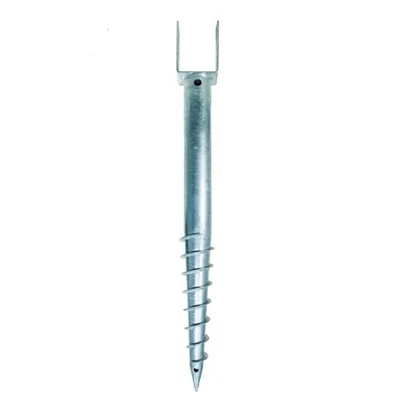
Helical pile are a newer product that seems to have emerged from the electrical power distribution industry, were anchors designed to hold up power transmission poles "screw" into the ground. If I am not mistaken, Hubbell Industries developed the first used in the United States, and they have become common here in the Florida Panhandle, where sandy or wet soil limits options for strong foundations to augercast or driven precast piling.
using helicals to increase the load bearing capacity of a foundation where the footprint had to fit between existing structures. Seeing the device driven into the ground with a hydraulic motor on the end of an excavator boom turning 5000 pounds of torque, watch the grout column placed around the head (top) of the pile, and installing the bearing plate made me think to myself…why are we wasting this money? We are driving a $1200 piece of steel into the ground, creating a literal nest of rebars around the top of it, then pouring more concrete, and for the life of me, I simply wasn't impressed. For one thing, the pile shaft, 2 inch thick galvanized steel, twisted under the torque. Even with the grout column encasing it, it just looks like an oversized screw driven into the soil.
but in my opinion, they are tremendously over-rated. " Frank Robertson said.
Are ground screw foundation tremendously over-rated?
Ground screw foundations - steel piles with helical threads that are twisted into the soil to provide structural support - have gone from a niche construction method to a high-profile solution in renewable energy, modular building, and even agricultural infrastructure. They are marketed as faster, greener, and more adaptable than concrete foundations. But are they truly as revolutionary as some claim, or are they a victim of their own hype?
To answer that, we need to look at both sides: the real influence ground screws have had on the construction world and the limits that sometimes get glossed over.

1.
(1) Speed and Labor Efficiency
One of the biggest contributions ground screws have made is cutting installation time dramatically. While concrete foundations require excavation, formwork, pouring, and curing - sometimes taking days or weeks - ground screws can be installed within hours and used immediately. This has been a game changer for projects on tight timelines, from solar farms to pop-up event structures.
(2)Versatility in Different Applications
- : Solar panel arrays, wind turbine bases.
- : Greenhouses, movable poultry coops, livestock fencing.
- : Road signs, guardrails, pedestrian bridges.
- : Modular and prefabricated homes, cabins, and tiny houses.
Their adaptability to sloped, rocky, or soft soils has made them valuable in regions where traditional foundations would require costly engineering solutions.
(3)Lower Site Disturbance
Because they don't require large-scale digging or concrete pouring, ground screws have influenced the way developers think about "light-touch" construction. In environmentally sensitive areas - wetlands, forest clearings, archaeological sites - this minimal disturbance can preserve vegetation, wildlife habitats, and groundwater integrity.
2.
Concrete production accounts for roughly 8% of global CO₂ emissions. Ground screws bypass much of that by replacing large footings with steel, which has a lower carbon footprint per unit of structural support when recycled content is considered. This has made them attractive in the "green building" movement.
Unlike buried concrete, ground screws can be removed and reused at the end of a project's life. This is important for temporary installations like festival stages or seasonal agricultural setups. In theory, this supports a circular economy approach to construction materials.

3.
In small-to-medium-sized projects, especially in off-grid or remote locations, ground screws have reduced costs by eliminating heavy equipment needs and reducing skilled labor hours.
By making construction in difficult soils or remote sites more feasible, ground screws have opened new opportunities for rural housing, mobile structures, and renewable energy deployment - especially in developing countries where traditional infrastructure is costly to deploy.
4. Long-Term Global Influence
Regardless of whether they are "overrated," ground screws have undeniably shifted expectations in the construction world toward faster, cleaner, and more flexible foundations. Their influence extends beyond the product itself:
- : Some building codes now explicitly recognize screw piles as a standard foundation type, streamlining approval processes.
- : Competing foundation technologies - such as driven steel piers or precast modular footings - have evolved to match the speed and low impact of ground screws.
- Climate-conscious design: By proving that construction can avoid heavy excavation and concrete, ground screws have nudged the industry toward considering life-cycle impacts more seriously.
, but not without substance. They've genuinely influenced the way the world thinks about building foundations, especially in renewable energy, modular housing, and eco-sensitive projects. Their speed, adaptability, and lower environmental footprint have opened new possibilities.